Living Heritage
Experience Kazakh Culture
To understand Kazakhstan is to understand the heart of the nomad — a deep kinship with untamed nature, equestrian mastery, poetic music, and legendary hospitality.
To understand Kazakhstan is to understand the heart of the nomad — a deep kinship with untamed nature, equestrian mastery, poetic music, and legendary hospitality.
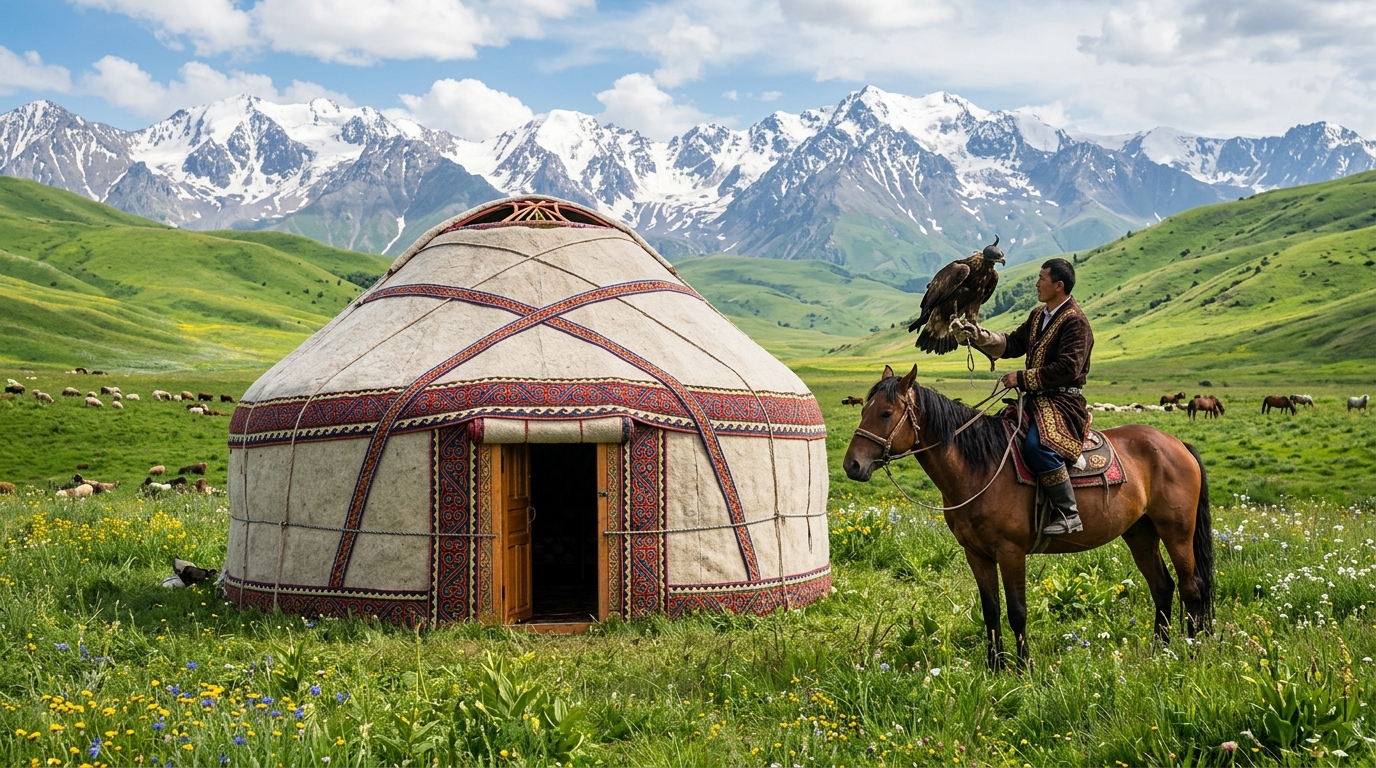
The Kazakh yurt is an engineering masterpiece of portability and environmental harmony. Built without a single metal nail from flexible willow wood lattice (kerege), curved roof poles (uwyq), and thick pressed sheep felt, it stays cool during scorching steppe summers and warm in sub-zero winters.
At the top sits the Shanyrak — the circular crown. In Kazakh culture, looking up at the sky through the Shanyrak connects generations. It is so revered that it forms the centerpiece of the national emblem of Kazakhstan.
For over 4,000 years, hunters across the Altai and Tian Shan mountains have forged unbreakable bonds with the golden eagle (Berkut). Young eaglets are taken gently from the highest crags and raised as beloved members of the family for over a decade before being returned to the wild.
Perched on the leather-gauntleted arm of a mounted horseman, the eagle swoops down from mountain thermals at speeds exceeding 250 km/h. Travelers can witness this majestic sport during annual ethno-festivals and private demonstration flights.
The Dombra is a pear-shaped, two-stringed musical instrument that serves as the acoustic memory of the Kazakh people. Renowned bard-composers (akyns) engage in rapid poetic duels known as Aytys, improvising philosophical verse and lightning-fast musical narratives called Küy.
Equestrian games like Kokpar (fierce polo-style teamwork) and Kyz Kuu ("Catch the Girl") showcase unmatched riding skills inherited from ancient steppe horsemen.
Explore Kazakh Gastronomy →Type at least 2 characters to search across all Kazakhstan destinations...